Wayne Quality Roofing handles chimney repair in Wayne, NJ, serving surrounding cities including Totowa, Pequannock, Lincoln Park, Franklin Lakes and Woodland Park. Our chimney work focuses on where the chimney meets the weather: the flashing that seals it to the roof, the cricket behind it, the crown and cap on top and the mortar joints in between. After more than 20 years of tracing roof leaks, we find that chimneys are one of the most common sources.
A chimney leak rarely shows where it starts. Water that gets past a cracked crown can travel down inside the masonry, and water behind loose flashing runs along the rafters before staining a ceiling. We look at the chimney from the roof and from the attic before we decide what needs fixing.
You get a written price for the specific repair and a plain explanation of what failed. If the chimney needs masonry work beyond what we do, we tell you that as well.
Chimney Flashing
Step Flashing Along the Sides
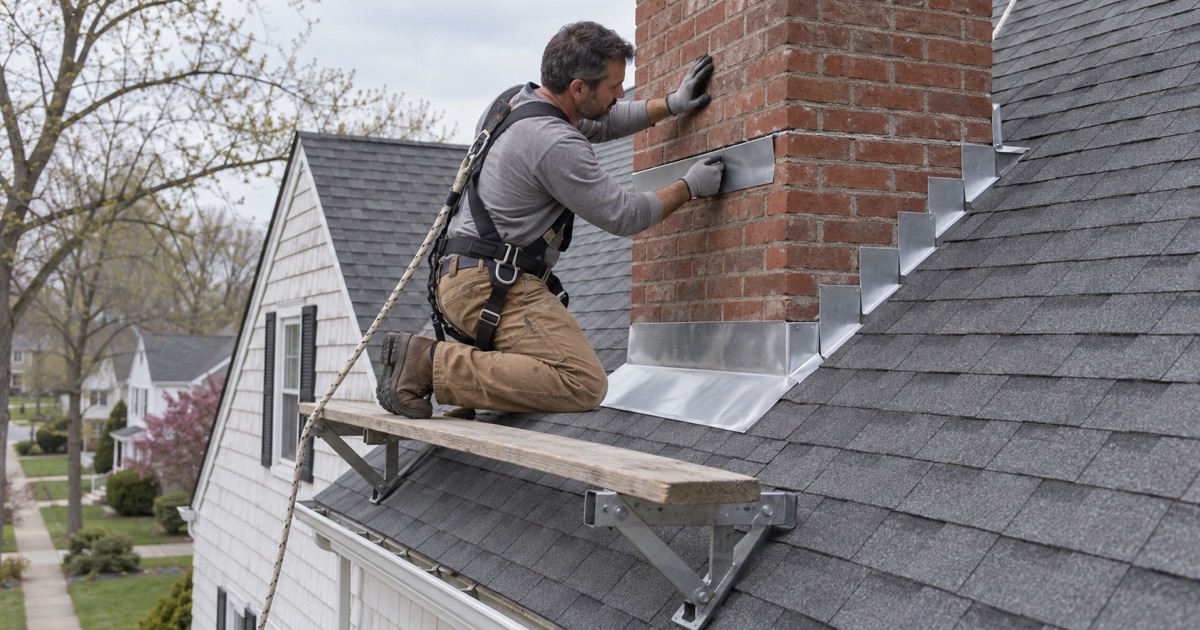
Step flashing is a series of bent metal pieces woven into each course of shingles along the sides of the chimney. Each piece overlaps the one below, so water running down the roof is carried past the chimney. When pieces are missing, rusted or installed as one long strip, water gets behind them.
We replace failed step flashing piece by piece with the shingles, which is the only way to do it correctly. On a roof replacement, the old step flashing comes off and new metal goes in, never reused under fresh shingles.
Counter Flashing Set Into the Mortar
Counter flashing covers the top edge of the step flashing and is set into the chimney itself. Done properly, it is bent into a reglet cut into a mortar joint and sealed there, so water running down the brick lands on the outside of the flashing.
Many leaking chimneys have counter flashing that was simply nailed to the face of the brick and caulked. Once the caulk dries out, water runs straight behind it. We cut proper reglets and install new counter flashing that does not depend on sealant alone.
Apron Flashing at the Front
The apron is the piece of flashing across the downhill face of the chimney, laid over the shingles below. It carries water off the front of the chimney and onto the roof. When it lifts or corrodes, water gets under the shingles just below the chimney.
We replace the apron along with the side and counter flashing so the whole chimney is sealed as one system. Mixing old and new pieces leaves a weak link.
Crickets Behind the Chimney
Why a Cricket Matters
Water running down the roof hits the back of the chimney and has nowhere to go, so it pools against the brick and works its way under the flashing. Snow and leaves build up there too. A cricket, or saddle, is a small peaked roof built behind the chimney that splits the flow and sends it around both sides.
The residential code calls for a cricket behind chimneys wider than 30 inches. Many older houses have wide chimneys with no cricket at all, and the back of the chimney is where their leaks start.
Building and Flashing a Cricket
We frame the cricket on the roof deck behind the chimney, cover it with ice and water barrier and then flash it with metal or shingles that tie into the chimney’s counter flashing. The result directs water away from the back wall instead of trapping it there.
Adding a cricket is easiest during a roof replacement, but it can be done as a separate repair. We recommend it whenever we find a wide chimney leaking at the back.
Chimney Crown, Cap and Masonry
Cracked Chimney Crowns
The crown is the concrete or mortar slab that seals the top of the chimney around the flue. It is exposed to every freeze and thaw, and once it cracks, water runs into the masonry below. That water can show up as a leak in the attic or damage the brick from inside.
We repair small cracks and rebuild crowns that have broken apart. A properly built crown overhangs the brick slightly and slopes away from the flue, so water drips clear of the chimney walls.
Chimney Caps
A chimney cap covers the top of the flue to keep rain, snow, leaves and animals out. Without one, water falls straight down the flue, and debris can block it. Caps with mesh sides also keep birds and squirrels from nesting inside.
We install caps sized to the flue and fastened securely, so they stay in place in high wind. Where a chimney has more than one flue, a single cap covering them all is often the neatest option.
Repointing Mortar Joints
Mortar joints wear away over time, especially near the top of the chimney where weather hits hardest. Open joints let water into the brick, and repeated freezing can crack and spall the face of the brick.
Repointing means grinding out the worn mortar and packing in fresh mortar to restore the joints. We repoint the areas that affect the roof and flashing, and we recommend a mason for chimneys that need rebuilding above the roofline.
When Chimney Work Fits a Roof Project
Chimney Repair During a Roof Replacement
A roof replacement is the best time to address the chimney, because the shingles and old flashing around it are coming off anyway. New step, counter and apron flashing, a new cricket where needed and any crown or cap repair can all happen in the same job.
We include the chimney work as separate lines in the roof estimate, so you can see what each part costs. That makes it easy to compare with another quote.
Removing Unused Chimneys
Some houses have chimneys that no longer serve a furnace or fireplace. An unused chimney still needs maintenance, and its flashing still leaks. In some cases, removing the chimney below the roofline and closing the roof over it eliminates the problem.
We discuss whether removal makes sense for your house and what it involves. Any structural or code questions are checked before we recommend it.
- 20+ Years in Roofing
- Line-Item Written Estimates
- Same-Day Storm Tarping