
Wayne Quality Roofing handles roof leak repair in Wayne, NJ, serving surrounding cities including Totowa, Pequannock, Lincoln Park, Franklin Lakes and Woodland Park. After more than 20 years of chasing leaks through attics and across roofs, we know that the stain on your ceiling is rarely directly below the hole. Finding the real entry point is most of the job, and it is the part a quick patch skips.
Every leak call starts in the attic as well as on the roof. From inside, we can follow water stains along rafters and sheathing back toward the point where water first gets in. That path tells us where to look outside, and it keeps us from replacing sound shingles over a leak that is actually coming from a flashing or a vent.
Once the source is confirmed, you get a written price for repairing it and a plain answer on whether the rest of the roof is sound. If the leak is the first sign of a roof at the end of its life, we tell you that too.
How We Trace a Roof Leak
Reading the Attic First
Water leaves a trail in an attic: dark streaks on the underside of the sheathing, stained rafters, rusted nail tips and compressed or discolored insulation. We follow those marks uphill from the stain to the highest point where water appears. That point is usually close to where it enters through the roof.
The attic also shows whether the water is coming from the roof at all. Frost on nail tips and widespread damp sheathing point to condensation, and a bath fan venting into the attic can drip on a ceiling just like a leak. Ruling those out first saves you from paying for the wrong repair.
Matching the Path to the Roof Surface
With the entry area marked from inside, we go onto the roof and check every possible source in that zone. We look at flashing, pipe boots, nail pops, cracked or lifted shingles and any valley or joint above the marked spot. Water travels downhill and along framing, so the cause is often a few feet higher than the stain.
When there are several possible sources, we work through them one at a time rather than replacing everything at once. That approach costs less and confirms which repair actually stopped the leak.
Water Testing Stubborn Leaks
Some leaks only appear in wind-driven rain from one direction or during a thaw, and they cannot be found on a dry day. For those, we run water over sections of the roof in a controlled order while someone watches from inside. When the drip appears, we know exactly which section is responsible.
Water testing takes longer than a visual inspection, but it ends the cycle of guessing and repeated callbacks. We use it on leaks that have already been patched without success.
Where Roof Leaks Usually Start
Chimney Flashing
Chimneys are among the most common leak sources we find. The step flashing along the sides, the counter flashing set into the brick and the apron at the front all depend on tight mortar joints and intact metal. As mortar cracks and sealant dries out, water slips behind the flashing and into the framing.
We rebuild failed chimney flashing with new step and counter flashing, the counter flashing set into a cut reglet in the mortar. Wide chimneys get a cricket behind them to divert water, and we check the crown and cap, because a cracked crown lets water into the chimney itself.
Pipe Boots and Roof Vents
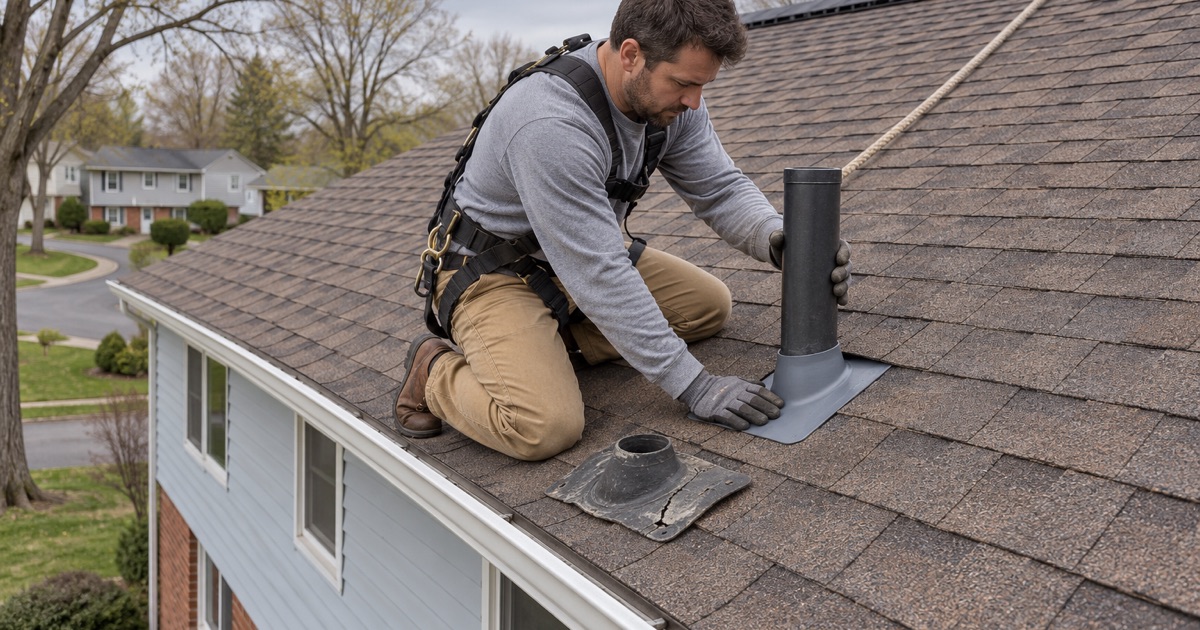
The rubber collar on a plumbing vent pipe cracks after years in the sun, and water then runs straight down the pipe into a wall or ceiling. These leaks often show up near bathrooms and kitchens. Exhaust vents and older roof vents leak the same way when their flashing loosens.
We replace cracked boots with new rubber or lead flashing boots, tucked properly under the shingles above. If several boots on the roof are the same age, we recommend replacing them together rather than waiting for each one to fail.
Valleys, Walls and Dormers
Valleys carry water from two slopes at once, so worn shingles, debris or poorly cut valley lines show up here first. Where a roof meets a wall or a dormer, step flashing has to be woven into each shingle course, and a kick-out flashing at the bottom throws water into the gutter.
When the kick-out is missing, water runs behind siding and rots the wall below, sometimes for years before anyone notices. We check valleys and wall joints closely and add missing flashing as part of the repair.
Skylights
Skylight leaks can come from the flashing around the curb, a failed seal in the glass unit or condensation forming on a cold frame. Each needs a different fix, so we check which one is responsible before recommending anything.
If the flashing is the problem, we reflash the curb properly into the roof. If the unit itself has failed, we discuss replacing it, ideally with the roof flashing kit designed for that skylight.
Winter and Storm Leaks
Ice Dams at the Eaves
Ice dams form when heat from the house melts snow on the upper roof and the water refreezes at the cold eave, creating a ridge of ice that backs meltwater under the shingles. The leak usually shows at an outside wall or the edge of a ceiling, often days after the snow stopped.
We repair the eave with an ASTM D1970 self-adhering ice and water barrier under the shingles and then check insulation and soffit ventilation. Older capes, ranches and split-levels are especially prone to ice dams, and without fixing the attic the dam will form again next winter.
Wind and Fallen-Limb Damage
Strong winds lift and crease shingles, open up flashing and drop limbs onto roofs, and the resulting leaks can appear immediately or with the next rain. Damage on wooded lots is often worse than it looks from the ground, because a limb can crack the decking beneath intact shingles.
We tarp the opening the same day after a wind storm, photographing everything before it is moved. The photos and a written description go to you for your own claim, and we come back for the permanent repair once the roof is dry.
After the Leak Is Fixed
Checking for Hidden Damage
A leak that has been running for a while can leave wet insulation, stained or soft decking and damp framing behind. We check the area around the leak from the attic after the repair and note anything that needs drying or replacing.
Wet insulation loses its value and can hold moisture against the wood, so we recommend replacing it when it stays damp. Decking that has gone soft is replaced as part of the repair, after we show it to you.
Deciding Whether to Keep Repairing
One leak on a sound roof is worth fixing. Several leaks in different places, along with brittle or curling shingles, usually mean the roof is wearing out and more leaks will follow.
After the repair, we tell you honestly which group your roof falls into. If it is the second, you can plan a replacement on your own schedule instead of reacting to the next storm.
- 20+ Years in Roofing
- Line-Item Written Estimates
- Same-Day Storm Tarping