Wayne Quality Roofing has handled roof repair in Wayne, NJ for more than 20 years, serving surrounding cities including Totowa, Pequannock, Lincoln Park, Franklin Lakes and Woodland Park. We fix lifted and missing shingles, failed flashing, cracked pipe boots, ice dam damage and worn flat-roof seams on houses and commercial buildings. Every repair starts with finding the real cause, because a patch over the wrong spot only moves the next leak a few feet.
That is why every repair visit includes the attic as well as the roof. Water that stains a ceiling has usually traveled along a rafter or across insulation before it shows, and the entry point can sit several feet uphill of the drip. We trace it back, mark it on both sides of the deck, and only then price the repair.
You also get a straight answer on whether your roof is worth repairing at all. Most roofs we look at need a repair, not a replacement, and we say so plainly. When a roof truly has reached the end of its life, we explain what we found and why another patch would be money poorly spent.
Residential Roof Repair on Shingle Roofs
Replacing Wind-Lifted and Missing Shingles
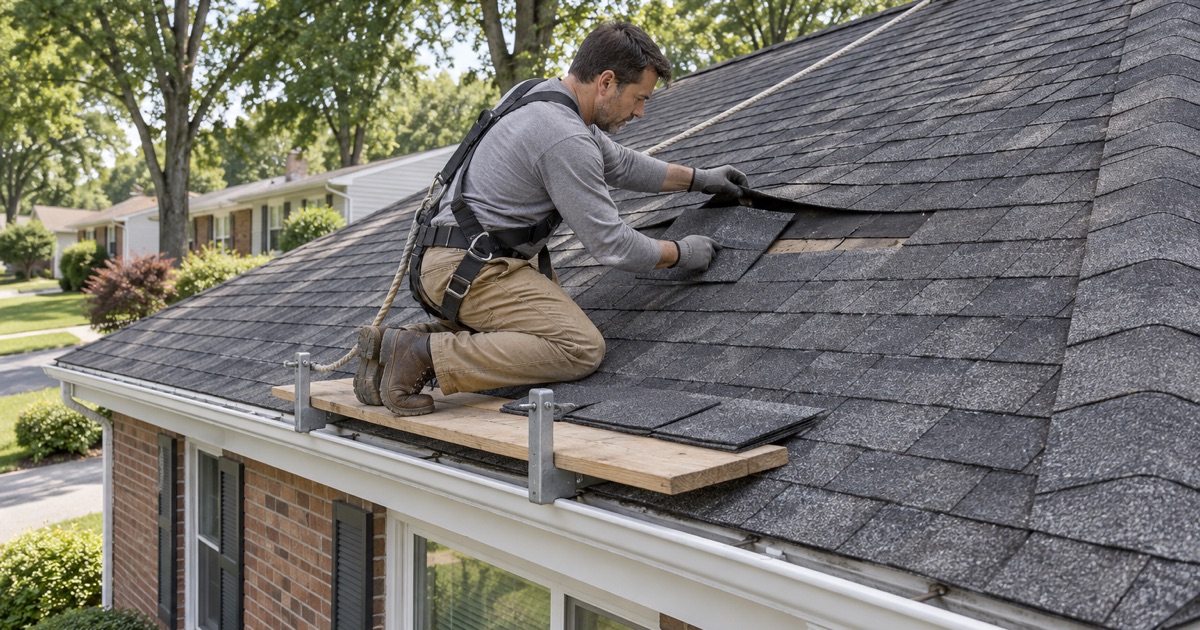
Wind gets under a shingle whose sealant strip never bonded or has aged out, lifts the tab and eventually tears it away or cracks it along the nail line. A single missing shingle exposes the underlayment, which is not designed to take sun and rain for long. We remove the damaged pieces, check the nails and underlayment beneath, and weave in new shingles that lock under the course above.
We also look at why the shingle failed in the first place. Nails driven too high or too few per shingle are a common cause, and if the pattern is wrong in one spot it is often wrong across the slope. When we see that, we tell you, because more shingles will follow in the next strong wind.
Flashing Repair at Chimneys, Walls and Valleys
Flashing is the metal that turns water away from every joint in a roof, and it fails long before the shingles do on many houses. Step flashing along a sidewall, counter flashing set into a chimney’s mortar joint, and the apron at the base of a chimney all work loose as mortar cracks and sealant dries. When they go, water runs straight behind them into the framing.
We repair flashing by replacing it, not by smearing roofing cement over the gap. Step flashing goes back in course by course with the shingles, and counter flashing is set into a cut reglet in the masonry rather than face-nailed and caulked. Where a lower roof meets a wall, we add a kick-out flashing so runoff lands in the gutter instead of behind the siding.
Pipe Boot and Roof Vent Repairs
The rubber collar around a plumbing vent pipe dries out in the sun, cracks and lets water run straight down the pipe into the house. It is one of the most common leaks we find, and it often shows up as a stain near a bathroom or around a light fixture. Roof vents and exhaust caps can fail the same way when their own flashing loosens.
We replace cracked boots with new rubber or lead flashing boots and slip them properly under the shingles above. Lead boots are dressed over the top of the pipe, which keeps them from cracking the way rubber does. If several boots on the same roof are failing, we recommend doing them all at once, since they aged together.
Repairing Ice Dam Damage at the Eaves
Ice dams form when warm attic air melts snow higher up and the water refreezes at the cold overhang, backing up under the shingles. The leak usually appears at an exterior wall or ceiling edge in late winter, sometimes days after the snow has stopped. Left alone, it soaks the top plate of the wall and the insulation above it.
Once conditions allow, we remove the damaged shingles at the eave, replace any soft decking and install an ASTM D1970 self-adhering ice and water barrier before re-shingling. We also check the insulation and soffit ventilation, because a dam that formed once will form again if the attic is still warm. Fixing the cause is what keeps the repair from being an annual visit.
Commercial and Low-Slope Roof Repair
Membrane Seams, Blisters and Punctures
Low-slope roofs on porches, additions, garages and commercial buildings use membranes rather than shingles, and they fail at seams, around penetrations and wherever someone has walked or dropped a tool. Modified bitumen develops blisters and open laps, EPDM seams lose adhesion, and TPO or PVC can split at a poorly welded seam. A small opening on a flat roof can let in a surprising amount of water because nothing sheds it away.
We identify the membrane before choosing a repair, because the methods are not interchangeable. Modified bitumen is patched with compatible torch-down or cold-applied material, EPDM with primed tape and cover strips, and TPO or PVC with heat-welded patches. A generic coating rolled over the problem may look tidy, but it rarely bonds to every membrane.
Drains, Scuppers and Ponding Water
Water that stands on a flat roof for days after rain speeds up membrane aging and finds every weak seam. The usual causes are clogged drains and scuppers, sagging decks and roof insulation that has compressed or soaked through. Leaves from nearby trees make drain clogs a regular fall problem.
We clear and reflash drains and scuppers, replace wet insulation where we find it, and add tapered insulation or crickets to move water toward the outlets where the roof allows. On each visit we note where water is collecting, so you can see whether the problem is getting better or worse over time.
Rooftop Units and Curb Flashing
Heating and cooling units, exhaust fans and skylights sit on curbs that have to be flashed into the membrane. Service technicians walking to and from those units, and the vibration of the equipment itself, wear the flashing faster than the open roof. Many commercial leaks we find start right there.
We reflash curbs to the membrane manufacturer’s details and protect high-traffic paths with walkway pads where needed. If a unit is being replaced, coordinating the roof work with the mechanical contractor saves cutting into new flashing twice. We are glad to schedule around your HVAC service so the roof and equipment are done in the right order.
How We Find a Leak Before We Fix It
Starting in the Attic
From inside the attic we can see wet sheathing, stained rafters, rusted nail tips and damp insulation that never show from the roof. Those marks tell us where water is actually entering and how long it has been happening. They also show whether the problem is a roof leak at all, since condensation and bathroom fans venting into the attic produce similar stains.
We photograph what we find and mark the suspected entry point. On a finished attic or a cathedral ceiling, where the deck cannot be seen, we work from the stain pattern, the roof layout and a careful look at each penetration and joint above it.
Matching the Leak Path to the Roof Surface
On the roof, we look directly above and uphill of the marked point for anything that could admit water: a cracked boot, open flashing, a nail pushed up through a shingle, or a valley packed with debris. Water follows gravity and framing, so the culprit is almost never directly over the stain. Checking each candidate in order is slower than guessing, but it gets the leak fixed the first time.
When the cause is still unclear, we can water-test sections of the roof while someone watches from inside. That pins down intermittent leaks that only show in wind-driven rain from one direction. It takes longer, but it ends the cycle of repeated patches.
A Written Repair Scope With Photos
Before any repair begins, you get a written scope naming what failed, what we will replace and what it costs. Photos from the attic and the roof go with it, so you can see the problem for yourself rather than taking our word for it. If we find something during the repair that changes the scope, we show you before going further.
The written scope matters if you ever sell the house or file a claim. It records what was done and when, and it gives the next roofer or inspector a clear history of the roof.
Deciding Between Repair and Replacement
When a Roof Is Still Worth Repairing
A roof with a single failed detail, such as one chimney flashing, a few wind-damaged shingles or a cracked vent boot, is almost always worth repairing. The same goes for a newer roof with an installation defect in one area. Repairs like these cost a fraction of a new roof and can add years of service.
We look at the overall condition while we are up there, including granule loss, brittleness and the state of the other penetrations. That way you know whether the repair is buying a long stretch of time or just a season.
When It Is Time to Replace
Shingles that are curling, cracking or bare of granules across whole slopes, decking that is soft in several places and leaks at more than one point usually mean the roof is done. Patching one spot on a roof like that tends to push water to the next weak point. Repeated repair bills soon add up to a meaningful share of a new roof.
In that case we explain what we found, show you the photos and give you a straight answer. Replacement only comes up when a repair genuinely will not hold, and the decision stays yours.
Repairs on Older and Slate Roofs
Older houses sometimes carry natural slate, or two layers of asphalt shingles, or a mix of materials from different decades. Slate repairs use matching slates fastened with slate hooks or copper nails, never roofing cement, and most slate leaks start at worn valleys and flashing rather than the stone itself. Older painted fascia and trim may need lead-safe work practices under the EPA RRP rule on homes built before 1978.
On a roof with two layers, repairs are possible but harder, because a soft or rotted deck hides under both. New Jersey’s rehabilitation subcode also requires a full tear-off when such a roof is eventually replaced, so we factor that into any advice on how long to keep repairing it.
- 20+ Years in Roofing
- Line-Item Written Estimates
- Same-Day Storm Tarping