
Wayne Quality Roofing handles skylight installation in Wayne, NJ, serving surrounding cities including Totowa, Pequannock, Lincoln Park, Franklin Lakes and Woodland Park. We install new skylights, replace old and fogged ones and reflash skylights that have started to leak. As roofers with more than 20 years in the trade, we treat the skylight as part of the roof, because that is where a skylight succeeds or fails.
A skylight is a hole in the roof, and keeping it watertight depends on flashing more than on the glass. We install each unit with the manufacturer’s flashing kit, an ice and water barrier around the opening and shingles woven into the flashing, rather than relying on caulk.
You get a written scope for the skylight, the framing and the interior finish, listed separately. If the skylight is being done with a new roof, it appears as its own line in the roof estimate.
Skylight Types
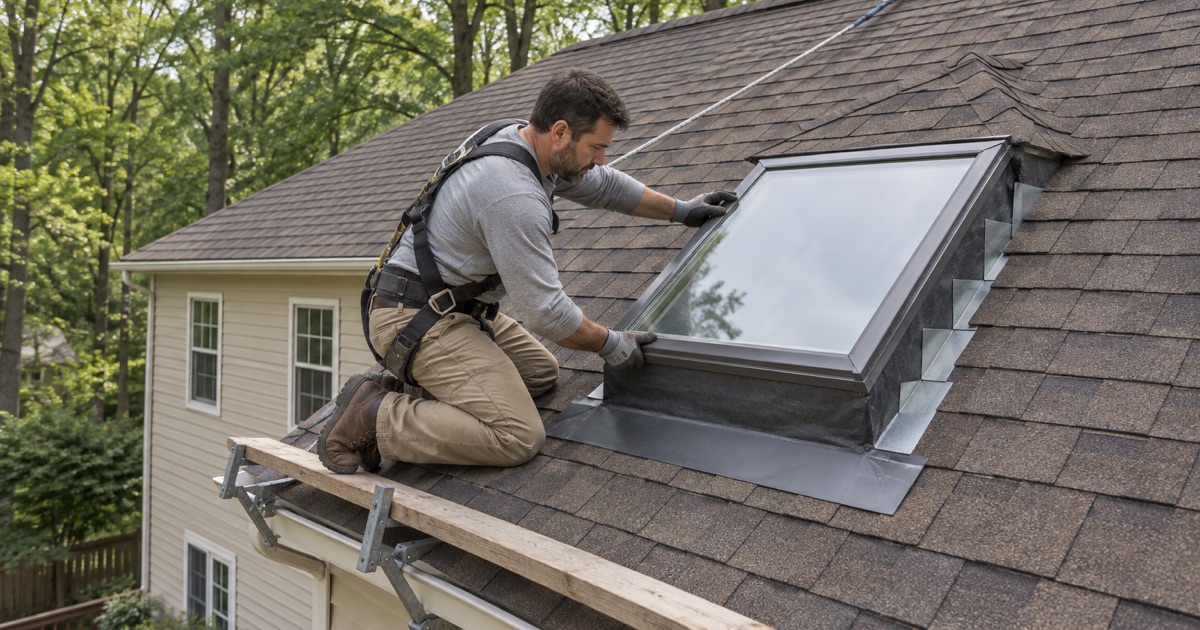
Curb-Mounted Skylights
Curb-mounted skylights sit on a raised wooden frame built on the roof deck around the opening. The curb lifts the unit above the roof surface, and the flashing wraps up its sides. They are common on low-slope roofs and as replacements for older units that already have curbs.
We build or repair the curb, wrap it with an ice and water barrier and flash it to match the roof covering. On a membrane roof, the membrane is carried up the curb and terminated beneath the skylight frame.
Deck-Mounted Skylights
Deck-mounted skylights attach directly to the roof deck and sit lower, giving a sleeker profile on shingled roofs. They rely on a flashing kit designed for the specific unit, which interlocks with the shingles around it.
Most new residential skylights on pitched roofs are deck-mounted. We install them with the matching manufacturer kit, because a generic flashing approach is where many skylight leaks begin.
Fixed, Venting and Tubular Skylights
Fixed skylights bring in light only, while venting skylights open to release heat and moisture, which suits bathrooms and kitchens. Some venting units open manually and others by motor or remote.
Tubular skylights use a small roof dome and a reflective tube to bring daylight into hallways, closets and small rooms where a full shaft would not fit. We recommend the type based on the room and what you want from it.
Installing a New Skylight
Choosing the Location
The best spot depends on the room, the rafters and the attic space between the ceiling and the roof. A skylight that lines up with the rafter spacing needs less framing work, while a larger unit may require cutting a rafter and framing a header.
We look at the roof and attic before recommending a location, and we consider sun exposure. A large skylight on a south-facing slope can add significant heat in summer.
Framing and the Light Shaft
Cutting into the roof means framing the opening correctly so the roof loads are carried around it. In houses with attics, a light shaft has to be built from the roof opening down to the ceiling, insulated and finished.
The shaft can be straight or flared to spread more light into the room. We frame and insulate it so it does not become a cold spot where condensation forms in winter.
Flashing and Underlayment
Around the opening, we install an ASTM D1970 self-adhering ice and water barrier lapped up the sides of the skylight frame. The flashing kit then goes on in sequence with the shingles: head flashing at the top, step flashing along the sides and a sill flashing at the bottom.
This layered approach sends water around the skylight even if wind drives rain under the shingles. It does not depend on sealant, which dries out over time.
Skylight Replacement and Repair
Signs a Skylight Needs Replacing
Fogging between the panes means the seal has failed and the glass unit has lost its insulating value. Cracked or crazed domes, rotted frames and repeated leaks after repairs are also signs that replacement makes more sense than another fix.
When we replace a skylight, we also replace its flashing and the underlayment around it. Reusing old flashing with a new unit simply moves the problem to a new skylight.
Reflashing a Leaking Skylight
If the skylight itself is sound but water is getting in around it, the flashing is usually the cause. Common problems are flashing installed without a kit, missing step flashing along the sides and caulk used in place of proper laps.
We remove the shingles around the skylight, replace the flashing with the correct kit and reinstall the shingles. That fixes the leak at its source rather than adding more sealant.
Condensation Versus Leaks
Not every wet skylight is leaking. In winter, warm, moist air from the room can condense on the cold glass and run down the shaft, looking very much like a leak.
We check whether the water appears only in cold weather and whether the shaft is insulated. Better insulation, a venting unit or more efficient glass usually solves condensation without any roof work.
Skylights and Roof Replacement
Coordinating With a New Roof
The ideal time to replace or add a skylight is during a roof replacement, when the shingles around it are coming off anyway. New flashing goes on with the new roof, so everything is sealed together.
If your skylights are older or fogged, we recommend replacing them in the same job. Doing it later means cutting into a new roof and disturbing fresh flashing.
Removing a Skylight You No Longer Want
Some owners decide an old skylight causes more trouble than it is worth, whether from repeated leaks, summer heat or a room layout that has changed. Removing it means framing the opening closed, installing new decking, and continuing the underlayment and shingles across the patch so it blends with the rest of the roof.
Inside, the light shaft is closed off, insulated and finished to match the ceiling. Like adding a skylight, removing one is easiest during a roof replacement, when the shingles around it are coming off anyway and the patch disappears into the new roof.
- 20+ Years in Roofing
- Line-Item Written Estimates
- Same-Day Storm Tarping