Wayne Quality Roofing provides commercial roofing in Wayne, NJ, serving surrounding cities including Totowa, Pequannock, Lincoln Park, Franklin Lakes and Woodland Park. We repair, replace and inspect the low-slope roofs on offices, shops, service buildings and small commercial properties. Our crews have spent more than 20 years on roofs, and on commercial work that means knowing the membranes, the drains and the rooftop equipment that shingle-only crews rarely touch.
Commercial roofs are regulated differently from houses in New Jersey. The ordinary-maintenance rule that lets a homeowner re-roof a detached house without a permit does not reach an office, shop or warehouse, so a commercial re-roof is permit work through the local construction office. We plan for that from the first visit.
Every proposal is written with tear-off, insulation, membrane, flashing, edge metal and drainage as separate items. That lets an owner or property manager compare bids line by line and see exactly where the money goes.
Commercial Roof Systems
TPO and PVC Single-Ply Membranes
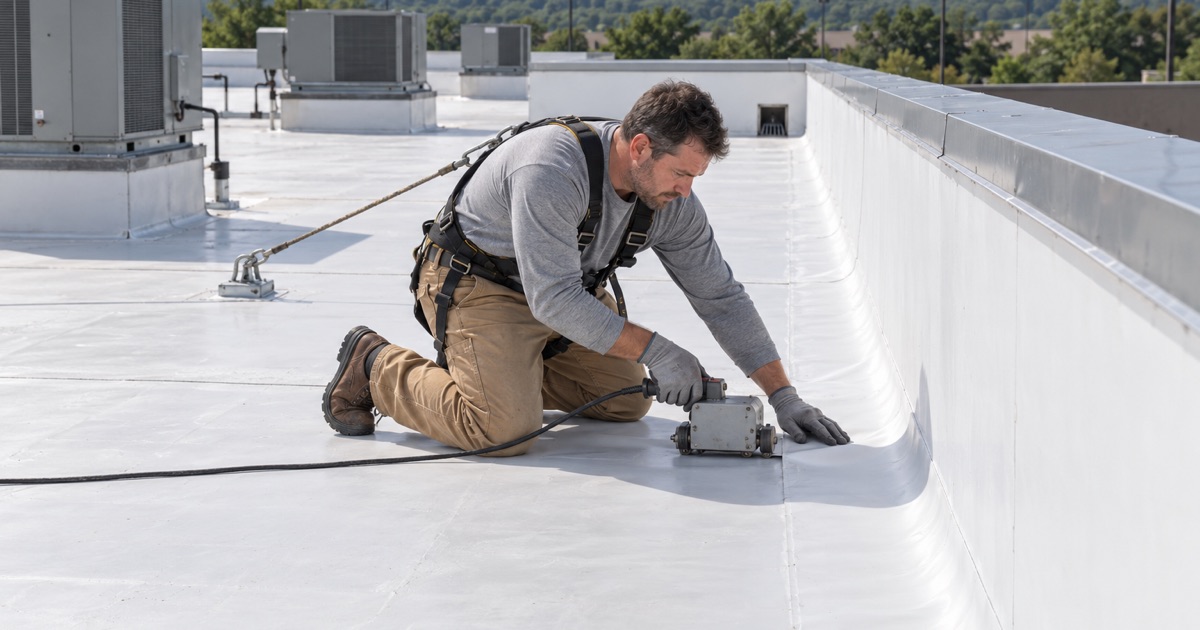
TPO and PVC are single-ply membranes rolled out in wide sheets and joined with heat-welded seams. A properly welded seam becomes part of the membrane, which makes these systems watertight at their weakest point. Their light-colored surfaces also reflect sunlight, which can help keep the building below cooler in summer.
PVC is often chosen where the roof sees grease or chemical exhaust, such as above restaurant kitchens, because it resists those better. We recommend between the two based on what the roof will be exposed to.
EPDM Rubber Roofing
EPDM is a synthetic rubber membrane, usually black, that has been used on low-slope roofs for decades. It is flexible in cold weather, tolerant of building movement and relatively simple to repair. Seams are joined with primed tape rather than heat, which makes careful preparation essential.
We repair EPDM with compatible primers, seam tapes and cover strips, and we replace it when shrinkage has pulled the membrane away from walls and edges. On an older EPDM roof, the condition of the seams usually decides whether repair or replacement makes sense.
Modified Bitumen Roofs
Modified bitumen comes in rolls applied by torch, cold adhesive or self-adhering backing, usually in two plies with a granulated cap sheet. Torch-down SBS and APP modified bitumen stand up well to foot traffic, which suits roofs with frequent equipment service.
We repair blisters, open laps and worn areas with compatible materials and reflash penetrations and walls. Where torch work is involved, we follow fire-safe practices, including a fire watch after work ends.
Commercial Roof Repair
Leaks at Seams, Edges and Penetrations
Most commercial leaks start at seams, at the roof edge or where something passes through the membrane. Pipe penetrations, curbs, parapet walls and edge metal all depend on flashing that ages faster than the open field of the roof. Water can then travel under the membrane before showing up inside, often far from its source.
We trace the leak path, probe for wet insulation and repair the membrane or flashing at the actual entry point. Each repair is photographed and documented, so the owner has a record of where the roof has needed work.
Drains, Scuppers and Ponding Water
Low-slope roofs depend on drains, scuppers and gutters to carry water off, and water that stands for days ages the membrane and finds every weak seam. Clogged drains, sagging decks and crushed insulation are the usual causes.
We clear and reflash drains, replace saturated insulation and add tapered insulation or crickets where the structure allows, steering water to the outlets. On buildings near trees, we recommend regular drain checks in the fall.
Rooftop Units and Equipment Curbs
Heating and cooling units, exhaust fans and skylights sit on curbs that are flashed into the membrane, and service traffic around them wears the roof quickly. Many commercial leaks begin at these curbs.
We reflash curbs to the membrane manufacturer’s details and add walkway pads along service paths. When equipment is being replaced, we coordinate with the mechanical contractor so the roof is opened and closed only once.
Commercial Re-Roofing
Tear-Off, Recover and Insulation
A commercial re-roof can mean tearing off the old system or, where conditions allow, installing a new membrane over it. A recover is only sound if the existing insulation is dry and the deck is solid, so we test for moisture before recommending one.
Wet insulation is removed and replaced, and new insulation is installed to improve drainage and energy performance. We explain the trade-offs in cost, weight and expected life for each approach.
Permits, Scheduling and Occupied Buildings
Commercial re-roofs in New Jersey are permit work, so we coordinate with the local construction office before the job begins. We also plan around the building’s occupants, scheduling noisy or torch work at suitable hours and protecting entrances and walkways below.
Crews working at the roof edge follow OSHA fall protection requirements. On multi-tenant buildings, we work in sections so each tenant knows when their part of the roof will be open.
Warranties and Ownership on Commercial Roofs
Membrane Warranties Versus Shingle Warranties
Residential shingle warranties do not carry over to commercial low-slope roofs. GAF’s current shingle warranty, for example, states that it does not cover low-slope membranes, and it limits corporation-owned and office buildings to 40 years rather than Lifetime on shingle sections. Commercial membranes carry their own manufacturer warranties with separate terms.
We explain which warranty applies to each part of your roof, what it requires and how long it lasts. That way the coverage is clear before the work starts, not after a claim.
Multi-Tenant and Leased Buildings
In a multi-tenant building, who pays for the roof depends on the leases, and the terms vary. A landlord may carry the whole roof, or each tenant may be responsible for the section over its space.
We document the roof’s condition for whoever holds responsibility and give separate scopes where sections are handled by different parties. Clear records help prevent disputes when a leak appears over one tenant’s space.
- 20+ Years in Roofing
- Line-Item Written Estimates
- Same-Day Storm Tarping